
A SHARED RESEARCH AGENDA
Explore beyond
what we know.
How can agents make verifiable discoveries—and become better discoverers?
What is Open World Discovery?
We use Open World Discovery as a broad organizing term for research on acquiring, constructing, and revising knowledge through exploration and learning in incompletely understood or changing worlds.
It brings open-world learning, scientific and causal discovery, discovery intelligence, self-evolving agents, recursive self-improvement, and open-endedness into a shared conversation. These communities retain their own definitions and objectives.
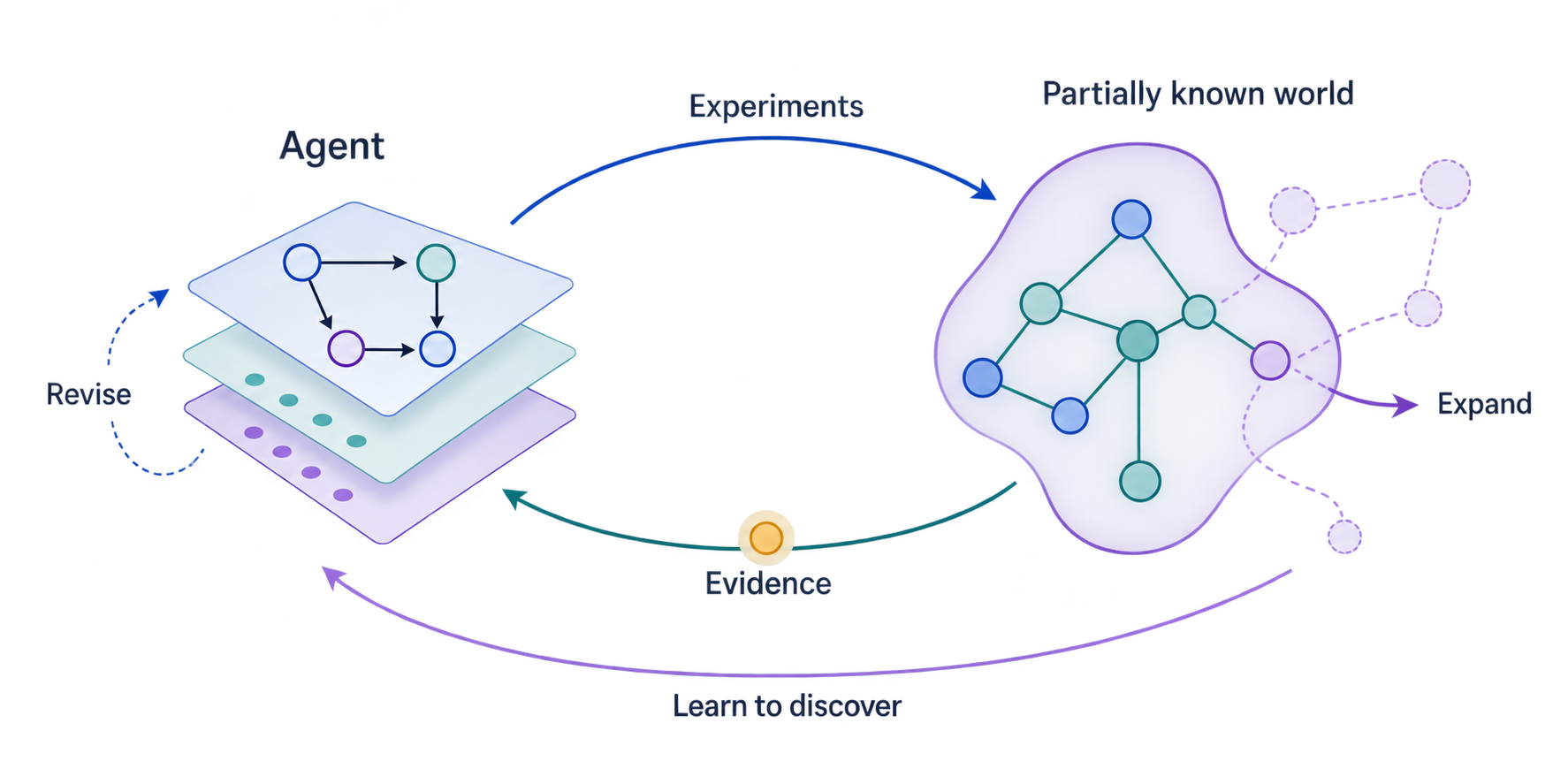
From unknowns to verified knowledge.
An agent forms hypotheses, chooses informative actions, gathers evidence, and revises its account of the world. The question, representation, or mechanism may itself need to change as an investigation develops.
We connect three objectives: building discovery agents, developing environments for meaningful investigation, and learning and evaluating discovery capabilities. Finding useful knowledge and improving the discovery procedure are related objectives, each requiring its own evidence.
Read the full scope and connections to related fields ↗EXPLORE THE FIELD
Eight questions for discovery.
Discovery Foundations
What constitutes a discovery?
13 works ↗02Discovery Representations
What representations enable discovery?
13 works ↗03Discovery Reasoning
How should agents formulate and test hypotheses?
16 works ↗04Discovery Training
How can we train agents to discover?
23 works ↗05Continual Discovery
How can agents learn from ongoing investigations?
25 works ↗06Discovery Systems
How can we build reliable discovery systems?
24 works ↗07Open-Ended Discovery
How can agents expand the scope of discovery?
15 works ↗08Discovery Evaluation
How can we measure progress in discovery?
23 works ↗